Here is the second part of the Future Cities story published in Dataquest. The stories written by me and featured herein are based on personal experience and secondary research. Suffice to say, that the issue was a personal favorite. I would like to thank all the people that took time out for me and were so very generous with there time. They might or might not be the future cities, but they sure are warm (emotionally) cities of India. Again like last time, this is the original and unedited version and would be quite different from the one that got published.
------------------------------------------------------------------------------
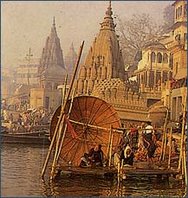
Allahabad: Holy modernity
It is a rather cruel irony that the point of reference for the Indian Standard Time or IST, actually lies very close to modern-day Allahabad. Thus every time an Indian checks his watch, he is actually checking what time is it in Allahabad. But for a city that gives us our time, time has more or less stood still. Indeed, Allahabad is completely devoid of any encumbrances of modernity.
A ride through the city on a three-tyred rickshaw driven my a thin skin and bones, would sufficiently convince you to either want to escape to back to modern times or probably enjoy the time and tide of the bygone era. It is quite a numbing experience.
Yet, wait a minute. When I refer to modernity, I do not mean the brands or technology – indeed, the latest and the best would surely be available in Allahabad. I hint at the comfort level of usage of computers in every day life. Even today for an average Illahabadi (resident of Allahabad), computer is a mysterious tool that has great promises but complex functions. It still scares him.
The reason is not hard to gauge, the biggest state in India, Uttar Pradesh, has also been the slowest in terms of IT adoption. There have been a few e-government projects, but they have been quite few and very far between. As, the private sector is more or less non-existent in UP, this has ensured that the computer has not really seeped into the very last nukkad. It is indeed a fact that UP has more or less miss the IT bus.
But there has been a ripple in Allahabad that just might turn into a wave and is worth mentioning. There are lots of prestigious universities and colleges in and around Allahabad, Banaras Hindu University is one and so is the Indian Institute of IT or IIIT Allahabad. It is these institutions that are driving IT adoption and purchase. Thus a majority of equipment is sold to these institutes and this is having its effect on Allahabad.
Today, there are quite a few communities of Allahabad on portals like Orkut. Even the government of India has done its nominal bit by setting up a STPI in Allahabad, thinking that companies would flock to a place like this. But they haven’t really. Till the ground level situation improves drastically not many companies would like to stick their neck in Allahabad.
But before we go, let me underline again the amazing intellectual and intelligent abilities of Illahabadis with an instance. Last year, the High Court in Allahabad was in news for very different reason. Thanks to a committee set up, the honorable high court went online so as to say, by having its own portal, http://www.allahabadhighcourt.com/. The best thing was, all the judgments of the court were not only available now in ODT and ODF format (the court underlined its commitment to FOSS), but they were available in RSS. Thereby making Allahabad court, the only probable court in the whole world to make judgments available through RSS.
Thus one might not be able to really see any outwards signs but a silent revolution of bits and bytes is indeed taking place in Allahabad, driven by institutes like IIIT Allahabad and others. So ignore this holy city at your own peril.
***
Surat: The jewel in the crown
Diamonds and Surat are synonymous, after all 92% of all diamonds in the world pass through the town. Surat is the diamond capital of the world, where much of the polishing and cutting takes place. Surat also happens to be the textile town, with scores of textile mills that lie in and around.
But the ascendancy (if we could term it as ascendancy) of Surat has not been sudden or in spurts. Since the times the Mughal dynasty ruled, Surat started emerging as a premier trade centre. Surat had a major port and trade tries spread all across the world. Also travelers to the annual Haj had to travel through Surat itself. So by the 17th century, Surat was one of the foremost cities of India, so alluring that even Shivaji sacked the city twice to be able to fund his war campaigns. The British East India Company for the first time settled their factory in Surat, before eventually shifting to Bombay. But then, things changed and Surat fell into disrepute.
Things went so bad that the city had to be quarantined because plague that spread across Surat. So that is story of fall of Surat.But now, thanks to vibrant support of the Gujarat government, the economy is again picking up. The state government has chalked an aggressive plan to promote the state as a knowledge hub and make best use of the intrinsic qualities of each city.
Since much of the gem and jewelry centers are present in the city, obviously it would be these firms that would take a lead in terms of modernization efforts. Thus the government announced the setting up of a special economic zone (SEZ) at Icchapore near Surat. Set to be completed this year, the SEZ will supposedly drive the economy of Surat in a big way. There will be quite a few specialized IT companies present in the SEZ that cater to the industry.The textile companies have also had an impact on the domestic market, as the mills like Govardhan, Everest and Motiani Fashions have modernized and used computers for mass scale production. This as coaxed companies like Sun Microsystems and IBM to have a focus on these markets as well. As much of the upper segment of tier I cities nearly taken, vendors are eagerly on the lookout for business potential of tier II and III cities. As many of the big players have given Surat a skip, it is the internal companies itself that have taken the onus of modernizing, like Asian Vision and Gati Softtech Solutions, etc.
Even the channel industry seems to be perking up to the opportunity, evident from the fact that they have been growing at a rate that is as good as any other in Gujarat if not better. The top three players from Surat are Jupiter Automation (annual turnover Rs. 25 crore), Valsons Computer (Rs. 22 crore) and Chopra Enterprises (Rs. 11 crore).
From the perspective of education, Surat offers good facilities like SVNIT, CKPCET, SCET, and others. This bodes well for the city as it looks to ramp up for growth for the future. Much of the growth again will come from the textile and jewelry business itself.
Surat is a vibrant city in close proximity to Mumbai. It is also immensely cosmopolitan city. A century or so ago, Russian literary stalwart Leo Tolstoy had crafted a short-story, wherein the action takes place in a Coffee-house of Surat. In it people from all across the world come together to discuss and debate on issues of varying interests. So there was a Persian mendicant with his African slave, a Hindu Brahmin, a Turk, a Roman Catholic, a Protestant, a Jew, a Chinaman, etc. Even to this day, Surat maintains the spirit of multi-culturism. History might not have been fair to Surat, bringing about constant upheavals in the city's fortune. Yet, the future beckons brightly, much like the diamonds that pass through the city and dazzle the world with the glitter.
***
Nashik: From Myth to modernity
Traveling through Nashik is an experience by itself, the outskirts of the city is as agrarian as you can get with the farmer and bull duo tilling the land and inside the city there are the multiplexes and the flyovers. So on one hand there exists a Nashik that is extremely rural, and on the very other it is up-to date and modern with all the computer hardware boards, etc. The dichotomy is hard to miss.
Even the agrarian picture is quite different from any in India. The small fields have these small bamboo sticks that jut out, a few feet in length and placed at some small distance apart in a very methodical way. Finally the whole field is covered with a parchment of sorts that conceals the fruit rather brilliantly. But then who does not know about those “sweet grapes” from Nashik. Much of the grape produce of Nashik is converted into fancy wine and sold under brands like Sula, etc. Passing through these fields, one cannot miss the similarities between Nashik and other popular wine destinations like Riviera or Napa valley.
Lying just a few hundred kilometers away from Mumbai, Nashik is indeed the place to be in. There is a hectic buzz of activity, of entrepreneurship, that truly sets the city out. Even the administration seems to have woken up to the potential of promoting Nashik and has started doing so in a small but significant way. There has been a concerted effort to start up industrial zones that more or less help the SMB segment. As of now, there are close to 6 MIDC and 10 Co-operative Industrial Estates in existence in and around Nashik and more are coming up. There has also an STPI established on the Ambad region.
In the past few years, industrial activity has really picked up in Nashik, especially after the launching of a mega SEZ in Sinnar area. Many reputed companies like Mahindra & Mhindra, MICO, Siemens, Crompton Greves, Kirloskar, Reymond steel, Jindal, Brook Bond, L&T, Ceat, VIP, Carbon Everflow, Garware, Jyoti Structures, Samsonite, Datar Switch Gears, Glaxo India etc. have established their units in Nashik. This has led to a spurt in IT adoption in the region. Even the PSUs are aiding the local economy, companies like India Security Press, Hindustan Aeronautics Ltd., Currency Note Press and Thermal Power Station etc. are located in Nashik.
The region also has more than its fair share of educational institutes. Around 9 government ITIs, 13 private ITIs, 2 engineering colleges and numerous other institutes. This ensures steady availability of talent for the industries. The big drawback as of now in Nashik is the power situation, frequent load shedding can be quite a bane. But then it statewide issue and not something specific to Nashik and as and when the issue is resolved for the state so will Nashik benefit.
Due to the close proximity of Nashik to both Mumbai and Pune, it has been touted as an ideal BPO destination. A vindication of the same was when WNS arrived in Nashik after acquiring ClaimsBPO, an offshore division of the US-based Green Snow Inc, which provided HIPPA-compliant BPO services. As of now, around 7-8 non-voice BPO companies, including Mumbai-based Tricom India and WNS Global Services, are working out of Nashik. There are also a close to a half-dozen smaller BPOs that have an average of around 50 each.
To sum up, Nashik is indeed a very good investment opportunity from the perspective of RoI and also the potential of growth. Not only that, the city is also renowned as a pilgrimage center, with the Shirdi close by and Sai Baba looking over the city. In fact, Nashik derives its name from an incident in Ramayana, wherein Lakshman cut off Ravan’s sister Soopankha’s nose (nasika/nak). The history of this region stretches out to pre-historic times. One can find almost everything in Nahik, right from modernity to mythology. The grapes are certainly sweetest, here!
***
Raipur: Emerging out of shadows
Here is a small test, ask any of your friends to identify Raipur on the Indian map, nine times out of ten, he or she will fail. Now, ask your friend where is indeed Raipur and even on this seemingly easy test, many will falter. And that sums up much of the problem with Raipur.
The capital city of new formed Chattisgarh state is not all that well-known on even a national scene. It has been over 6 years now since Chattisgarh was carved out of Madhya Pradesh. Lying on the precious mineral belt in central India, Raipur has a whole lot of mining companies that have set up operations in and around Raipur. Traditionally, the city of Raipur has been described as "an agricultural-processing and saw-milling town". The city is located centrally in the state of Chattisgarh, and serves as a regional hub for trade and commerce for a variety of local agricultural and forest products. There are several small-scale industries, which include oil milling, soap manufacturing and electrical welding.
Not only that the region is also emerging as an important educational hub. A lot many engineering colleges have come up in and around Raipur providing excellent educational facilities. In fact many domestic IT companies regularly go to these colleges for campus recruitments, companies like TCS, Wipro, Cognizant, iGate, and others. The famous colleges are Raipur Institute of technology, National Institute of Technology, AT College of Electronics and MJ College of Information Technology. These colleges ensure that there is a steady stream of employable talent available in Raipur. Though the government of Chattisgarh was caught in a situation when the Supreme Court came down heavily on the high number of universities cropping up, even Aptech had fallen for the lure and launched a university operations in Raipur.
The state government is also actively wooing IT companies and asking them to set up shop in Raipur and invest through the SEZ way. A few companies are supposedly assessing the possibility, whether it is feasible in the long-term considering the geo-politics of the region.
The government of Chattisgarh is actively promoting the use of ICT for development. In this regards, a host of e-governance initiatives have been launched within the state. Recently the state government launched the first e-Court system in Raipur. In fact, the government has created a vision document that speaks about how it will pursue e-governance initiatives. One of the objective that is representative of all, says, “ICTs will be used extensively in enhancing the productivities and efficiencies substantially in all the sectors of the economy, especially, agriculture, manufacturing banking and services sectors.”
The change is quite evident when one sees the emerging channel industry gaining strength and growing at a healthy rate. There are quite a few strong channel players in Raipur that mainly cater to the industries and the SOHO as well. Some of the names are, Priyanka Computer Services (annual turnover Rs. 22.79 crore), Balaji Computer (Rs. 12 crore) and Shriram Computers (Rs. 8.5 crore).
But the change is very evident, recently, the states and Raipur very first mall, 'City Mall 36' was inaugurated. The mall comprises number of national and international brands such as INOX, McDonalds, Big Bazar etc. According to news reports, Raipur is getting ready for 7 more such global malls by end of 2008 namely. Even the TAJ group of
Hotels has started the constructing its Five Star Hotel in Raipur. The government is also actively developing a vast tract of land near the city, dubbing it as Naya Raipur. The place is well-laid and would have the best infrastructure available in the whole of the state. According to many, once this project is completed, moving to Raipur (for IT majors) will not be difficult decision to make.
All these factors are indicative of major change that is happening on the ground at Raipur. For long it has remained under the shadows of bigger cities like Indore, Bhopal, Nagpur and others. Now it is finally ready to break out.
***
Chandigarh: Symbol of the future
Jawaharlal Nehru wanted to prove a point and many with Chandigarh. He envisaged the city to be a metaphor of modernity, a symbol of the tryst that we had embarked on. After having witnessed the bloodiest human migration in history in the form of partition, Nehru decided to build a beautiful capital city for the state of Punjab. He famously proclaimed Chandigarh to be "unfettered by the traditions of the past, a symbol of the nation's faith in the future." Like any of the city-builders in history, he would not leave a stone unturned. So the best architects were involved in the project, namely Swiss-born French architect and planner, Le Corbusier and American architect-planner Albert Mayer who was working with the Polish-born architect Matthew Nowicki. And thus Chandigarh came into existence.
Today some 5 decades or so later, one needs to revisit Chandigarh again to assess whether it is still a beacon for modern India or just milestone left behind. Speaking from the perspective of IT industry, Chandigarh has largely been a mixed bag. The biggest draw of the city is definitely the amazing infrastructure, the broad roads and the comfortable housing. Yet, IT companied have not really flocked to Chandigarh, setting up their shops. Rather strange, if one considers the fact that in North India, there is hardly any city that can stand in comparison of Chandigarh, with the possible exception of Gurgaon.
A host companies like Infosys, Quark, Dell, Webart Softech, Netsoft Informatics, and others have already set up base in Chandigarh. The government had some years launched the Mohali SEZ amidst much fanfare, though according to certain observers there hasn’t been much difference on the ground. Not only that, there have been numerous discussions on how well suited Chandigarh is for BPO work, a few companies have indeed set up shop like IBM Daksh, Kalldesk, Bay Infocomm, UCIL and others.
Now, another exciting project is coming up in close vicinity, an IT Township in SAS Nagar. A Consortium formed by Reliance Industries, real estate investor Landmark Holdings, Berggruen Holdings India, subsidiary of a New York-based company, and Punjab-based Yellow Stone, is expected to infuse over Rs 950 crore in the IT township. The project, to be set up within 10 km of the upcoming international airport at Chandigarh, is expected to set aside 60 per cent of its area for IT companies, 30 per cent for housing and 10 per cent for commercial operations. Considering the host of engineering colleges in the vicinity, Chandigarh still has the potential to be a symbol of the future, all it needs now is a big push, that’s it.
***
Coimbatore: Moving up with Speed
Like its beloved son, N Kartikeyan, Coimbatore also seems to be in love with speed. How else can one explain the rapid work that is taking place in Coimbatore. After Kochi, Coimbatore is place in South India that is witnessing a construction boom. And if that was not enough, a new IT park is being constructed by ELCOT and TIDCO.
Infrastructuraly speaking, Coimbatore has always been known for its well designed roads and well though out architecture. Renowned as the Manchester of the East, because of so many textile mills in close proximity. The city's primary industries are engineering and textiles. The district also houses the country's largest amount of hosiery and poultry industries. Most of the industries are run by entrepreneurs, often indigenous with family based or community financing. The city's industrial growth started in 1920’s and accelerated after independence, without any government assistance or the entry of external industrial houses. Of late, information technology companies have started opening offshore development centers in the city.
The result: a robust economy and a reputation as one of the greatest industrial centers in South India. The engineering prowess of Coimbatore can be gauged from the fact that TCS has already established its Centre for Engineering Services.Coming back to the park, according to reports, Wipro is quite keen to be the anchor partner for the park. Whereas there have been enquiries from Satyam, HSBC for back-end operations and a few companies from Bangalore and Chennai too for readymade space in Coimbatore to begin their operations. A CII-commissioned study by Pricewaterhouse Coopers indicates that companies setting up shop in Coimbatore can increase profits by 60 per cent compared to those in metros. Coimbatore has more than 80 engineering and arts and science colleges, so it has an abundance of talent for the kind of workforce required.
The city also boasts of two STPI earth stations, one at PSG- Science and Technology Entrepreneurial Park (STEP) and another at the KG Information Services Limited (KGISL) campus at Saravanampatti. But things are changing steadily. Some of the major industries are Lakshmi Machine Works(LMW), Premier Instruments & Control Limited(PRICOL), ELGI Equipments, Roots Industries, KSB Pumps, Dresser Valves, Flowserve, Janatics, Texmo Industries, Aquasub, Sharp Industries, CRI, Deccan Industries & ITC. Suzlon is also setting up a huge plant for renewable energy.
Also the fact that till quite sometime back, the minister at the Centre, Dayanidhi Maran was quite keen to see Coimbatore as a favored destination also helped.
***
Mangalore: Fishing for big investments
From a sleepy fishing hamlet to being the fastest growing non metro in South India, Mangalore (Mangalooru to be precise) has indeed transformed much over the years. Yet the transition is not that startling, simply because Mangalore always had the potential to emerge as one of the biggest cities of India, even in comparison to ‘former pensioner’s paradise’ that is Bangalore.
The reason is not much hard to find, since the middle ages, coastal Mangalore has always been a vital trading point on the western shore. Thus produce from surrounding areas namely Kerala, Goa and even Maharashtra was traded through the harbors of Mangalore. Thus, over the last many years a number of related industries came to exist in Mangalore. Right from coffee traders to ship building companies like Swan Aquatics, etc. Not only that, there are a few major chemical and fertilizer companies also present in Mangalore like Mangalore Chemical and Fertilizers Ltd. (MCF), Kudremukh Iron Ore Company Ltd. (KIOCL), Mangalore Refinery and Petrochemicals Ltd (MRP), BASF, ELF GAS, etc.
Nonetheless, Mangalore is ready to move to the next level, in fact it is very much doing so and is wooing IT companies in a big way. Infosys is truly the first and the biggest in Mangalore. Spread over an area of 300 acres, Infosys’s campus in Konaje is quite a landmark by itself. Infosys also has significant presence in Blue Berry Hill STPI in Mangalore. Wipro is also actively working on a facility in Mangalore to complement its huge campus in Mysore.
Meanwhile, there has been lot of talk of how well suited Mangalore is for BPO activities. According to many, the region has more scope for BPO than software because of the high education level. Mangalore has plenty of renowned schools and colleges in the city or the near vicinity, thereby supplying a large labor pool. Little wonder, than MPhasis BPO had set up shop in Mangalore. Not only Indian companies but even MNCs are keen to make a move to Mangalore. Take the case of First Indian Corporation; a wholly owned subsidiary of The First American Corporation has started operations in Mangalore.
As the city of Mangalore attracts investment, so is the infrastructure steadily growing. Off late, the Mangalore airport has been operational and there has also been quite some talk of making it international. With a host of engineering colleges in the vicinity (KERC and PA College), there is little doubt that Mangalore is going to be a major draw for IT companies (the IT exports from city will amount to Rs. 1000 crore by 2007 end). What remains to be seen whether this coastal paradise is able to retain its intrinsic charm in wake of all this high-fly investments. One sure hopes so.
***
Mysore: Not a mere satellite
For Mysore, its close proximity to Bangalore is both a boon and a bane. Indeed over the last few years, there has been a major spurt in investments in the hilly town due to the supposed saturation in Bangalore. Companies right from Indian IT majors to MNCs have in some way or the other chalked out a map to make use of Mysore mainly because of its close proximity to Bangalore. And this is quite disquieting.
Before India attained independence, Mysore was regarded as one of the premier princely states of India. Unlike many other royal maharajas who splurged money on themselves and themselves alone, the Wodeyars (the ruling family of Mysore) was certainly not the same. Take the case of Chikka Devraja Wodeyar, who ruled from 1673-1794 and widely reformed the empire by dividing it into sections called as chavadis. Meanwhile, Krishnaraja Wodeyar who ruled from 1902 to 1941 was largely responsible for much modernization of Mysore. Not only was he a great patron of art but also a visionary. He set up numerous educational institutes during his reign, the most memorable being the Indian Institute of Science at Bangalore (he gifted 11 acres of land for it).
Thus, Mysore was much modern before the Silicon magic wand transformed Bangalore. It never did have the big heavy industries, except for Mysore Sandal Oil Factory or Krishnarajendra Mills. Much of the industries were traditional in outlook and small in scale. So while Bangalore hogged the limelight as an IT hub, Mysore continued to retain its old world charm, as the cultural capital of Karnataka. But that is set to change as well.
For the industrial development of the city, Karnataka Industrial Areas Development Board (KIADB) has established four industrial areas in and around Mysore, namely, Belagola, Belawadi, Hebbal (Electronic City) and Hootagalli. This has resulted in fair amount of optimism among IT players about the potential of Mysore. Infosys has made a big splash already by setting up one of the largest technical training center in the world located over an area of 270 acre and can accommodate over 4500 trainees at a time. Wipro has also established its Global Service Management Center (GSMC) in Mysore to complement its facility in Bangalore. There have been a few BPOs also coming up in Mysore, Hinduja TMT launched a 1000-seater sometime back in Mysore
Mysore now boasts of a four-lane high-speed expressway from Bangalore and is hoping that the government keeps its word on providing better infrastructure, connectivity and the much publicized BPO park in Bogadi that would lead to the city's growth and attract more companies. In the year 2006-07, Mysore contributed Rs. 760 crores to Karnataka's Rs. 48,700 crore IT exports and has already overtaken Mangalore as the second largest IT center in terms of revenue. But there have been a few controversies as well, namely the tussle between Infosys and the former prime minister Deve Gowda on a range of issues from infrastructure development to things else.
All in all, Mysore needs to be assessed as a city by itself and not due to mere proximity to Bangalore and even on its sole merits it scores wonderfully well. It isn’t a satellite but a planet by its own.
***EOM***
Feature: Future cities of India -- II

Feature: Future cities of India
Getting to meet and interact with people from diverse cultures and different regions are certainly one of the biggest perks of being a journalist. People take time out for you, indulge you, talk, explain and often entertain you. You are not considered a hindrance and oft times are awarded warm welcomes. So when Dataquest decide to come out with an issue on emerging cities (later renamed as Future Cities) of India from the IT perspective, I was all excited. I got a great chance to visit cities like Kochi, Trivandrum, Nagpur and Vadodara. I met with people from different companies, from a scientist at BARC in Vadodara to VP from Lord Krishna Bank in Kochi to IT head at Haldiram in Nagpur.
Over a fortnight, I was travelling to all these cities and trying to create a true picture, finding out what makes the cities tick, what are the problems faced and what are the advantages that companies like Infosys, TCS or even IBM have from moving to cities like these. It was an enriching experience, as there was so much that I got to learn from so many people I met. Herein I am putting up the first three profiles of the places I visited. A small disclaimer; the pieces here might differ from the actual ones published due to numerous reasons like sharp editing or paucity of space. I would be putting up a post on my experiences in my personal blog (zewak.blogspot.com) soon enough. The three cities follow:
------------------------------------------------------------------------------
Kochi: Now the God’s have IT
The idyllic coastal township is set for big things, as now is banking on IT for them.
“Azim Premji is not only one of the richest Indian but also the toughest Indian to convince,” quips Girish Babu. He must know well because as the former CEO of Infopark, and COO of IT parks, Kerala; Babu was trying hard to convince Wipro to set up base in God’s own country. The sprawling Infopark had been operational in Kochi for year or two and a few entrepreneurs had taken space. But there could not be a better endorsement than Wipro and Babu was well aware of it.
Meanwhile, Wipro had also checked out Coimbatore and company officials were keen for a more developed and investor friendly Tamil Nadu over scenic but labor-issues ridden Kerala.
After much hard lobbying, Wipro set a condition; whichever state gives the company SEZ status first, will get the investment. Babu got cracking and within a day or two was ready with the letter and sent it across to the company. It was in September 2004 that Wipro acquired some 25 acres land and set up operations in the Infopark. “With Wipro much of the perception problem associated with Kerala was solved to a great extent and the gates were open for fresh new investments,” reminisces Babu.
Indeed post 2004, Kochi has literally donned new robes. A trip down the port city and one will be amazed at the frenetic activity all round; big billboards featuring Malayalam stars Mohanlal, Mamooty and even Hema Malini, lord over the cityscape. Newspapers are fully of adverts of upcoming luxurious residential projects all over. There is not a single global brand that would be missed at the malls lining the Marine Drive. Kochi, the commercial capital of Kerala, is shining bright much like the hundred of Alapatt and Alukkas gold showrooms spread all over.
A case of infrastructure
From back in the middle ages, Kochi had been a centre for trade and commerce. The port city had traders flocking in from Manchuria to Persia and beyond. It was a simmering pot of cultures and leisure, coaxing a Chinese traveler to comment that “If China is the place where you earn money, Kochi is the place to spend it”. When the Portuguese under the leadership of Vasco Da Gama were shunted out of Kozhikode (Calicut), they landed up in Kochi and set up the first European factory or trading post.
Post independence, Kochi lost the race for industrialization and the economy more or less stagnated even though the big companies were indeed present. “It was indeed ironical, as Cochin always was more progressive of the cities in all of Kerala. There was the prosperous port and refinery company and of course the Cochin Shipyard, the largest ship building facility in India. Yet the city did not much benefit from all these companies,” says MV Paul, deputy director (Systems), Cochin Port Trust.
Yet, Kochi maintains its lead in terms of physical infrastructure and can give any Tier II city a run for its money in terms of infrastructure. The city has a very reliable power supply, with close to 7 power stations in the vicinity feeding power to the city. There is also no shortage of water supply thanks to the Kadambariar river. And the best of all is the International Airport at Nedumbasserry, the first privately built airport in India. Today there are close to 450 landings every week at the airport and was the only airport in India where the Airbus A380 could land.
Close to the airport in Kakkanad, around 25 kms from the city centre, i.e., Ernakulam, are the upcoming IT hubs. The infrastructure is indeed mind-boggling, there are the broad 4-lanes roads and small landscaped gardens at the roundabouts and of course the imposing glass towers. Except for Infopark, there are new IT parks coming up from L&T, Leela, Muthoothu, and of course the SmartCity by a Dubai based conglomerate.
Little wonder, post Wipro, now TCS has also set up shop in the city. Infosys has agreed for investing in Technopark in Kerala and is also considering at some sort of investment in Kochi as well. According to a Nasscom report, Kochi is best suited for BPO, both voice and non-voice. Currently, ACS and Sutherland have big investment in the Infopark and the way they are expanding, the investment seems to be working. “Currently Kochi accounts for around Rs. 1000 crore of IT exports annually, it will overtake Trivandrum in sometime,” says Babu.
Doubly connected
Kochi is only the city in the country that is the landing point for both SEA-ME-ME3 (it lands in Mumbai) and SAFE undersea cables that connect the country to rest of the globe. Also, gigabyte router of VSNL gateway lies in the vicinity. Because of this unique characteristic, Kochi is always connected, and also best suited for voice based services due to less loss of time due to latency.
“Kochi is the best city in terms of bandwidth connection, as around 80% of Indian traffic is routed through the VSNL gateway. We are very bullish about the prospect of the city and keen to develop IT across the state through the hub and spoke model, where small centres will mushroom around bigger ones like Kochi and Trivandrum,” concurs KR Jyothilal, special secretary, Department of IT, Kerala.
The genteel Malayalee
If that was not good enough to convince people, there is of course the amazing manpower story from Kerala, the first state that was cent percent literate. Kerala also has the distinction of having the largest pool of English speaking manpower and the highest density of IT professionals. The world may have painted a sordid and a combative picture of a Malayalee that is constantly waving the red flag of protest.
But the reality is much in contrast. Thanks to decades of working in other more developed markets in the UAE and US, the modern Malayalee has a more global outlook that any of his up country cousins. Not only is he (or she) well aware of market dynamics but quite willing to inculcate the values of the service industry. Visit any hotel in the city and you will understand the change. The hammer and sickle are best left to the politicians while every one else seems to be pursuing the good ol’ Gandhi or even Monsieur Washington.
As Kochi is just a few hours away from Bangalore, much of the Malayalee professionals that had shifted to the city due to lack of opportunity are quite willing to head back home. Babu talks of how companies in Kochi realized that they had more walk-ins when they advertised the job openings in Bangalore and Hyderabad rather than in Kochi itself. And thanks to the many colleges in the vicinity there is also the abundance of raw talent. “One should hire the employee for his aptitude and train him for his talent. The professionals of this city have the best aptitude, thanks to it being a commercial city that one can find in Kerala or even in South India” says S Venkataraman, deputy director, Lord Krishna Bank (now Centurion Bank).
Red fears
While all may seem outwardly fine, there is indeed a lurking fear in the minds of players in Kochi about the future potential of the city, especially the flip-flop between the Congress and the Communist. While the government officials may argue that investment climate is not affected by change of governments. There does seem to be an ever-so-slight slowdown. Take the case of the SmartCity project, it was riled in controversy in Kerala, while both Karnataka and Andhra Pradesh were ready to offer concessions for the project to shift.
“Kochi has as good as a potential as Hyderabad or even Chennai. We have suffered because of lack of political will. Kerala had a head start over the others when we started with Technopark and yet we have lagged. It is a matter of leadership not ideology as even West Bengal is doing well even though it has been ruled by communists for decades. We are really praying for a good leader,” says Benley Noronha, managing director, Nortech Infonet.
For Ajith Brahmanandan, state information officer, NIC (Lakshwadweep), it is a matter of infrastructure and bad planning. “If you travel through the city of Kochi, especially through Ernakulam, what strikes one is the woe-full planning. In fact, there is no plan at all for the city even though it continues to burst at the seams with people and more people. The government really needs to pay attention to the basic infrastructure,” he says.
Jyothilal dismisses these concerns and terms them as teething troubles. “It is all perception. Even though the governments have kept changing, the policies have not deviated. Today the investment climate is independent of politics and everyone understands the value of IT. That is one of the reasons why the CM himself handles the IT portfolio. Even his son and so many other politicians children are working in the IT industry,” he states.
Whatever is the case of the political front. One thing is certain, Kochi is surely the place to be, if you are not already there. From the time Monsieur Da Gama landed (and subsequently died as well) in Kochi, the city has had a whole lots of firsts, be it the first territory to be colonized, the first state to join Indian dominion, the first to have a private airport, etc. the list just keeps going on. The idyllic backwaters, the scenic sea front and of course the innumerable getaways in close vicinity, makes Kochi a tempting place to shift. The reality market is really booming and everyday counts. After all if the one of richest man (supposedly the smartest as well) in India endorses the city, there is little that can really go wrong. Can it?
**EOM**
Nagpur: From Oranges to IT
Zeroing on the Zero Mile City of India
“What else can you get except oranges?” a friend of mine commented, before I set out for Nagpur. The “What else” really baffled me, indeed, come to think of it; there isn’t much that one associates the city with, except the citrus fruit.
With much apprehension, I landed at Dr. Ambedkar airport, only to find chaotic construction all around. There was much frenzy in the air and one could discern quite a few construction cranes in the foreground and the constant din that one associates with them. Five minutes out of the Airport and a first timer like me is bound to be taken aback by the physical infrastructure, the 4-lane concrete roads and the daunting flyovers. It is very unlike any Tier III (or even tier II) city that you will see in India. And that is biggest irony.
Nagpur, the second capital of Maharashtra is the largest city in central India. Located practically at the centre of India, India’s geographical centre (Zero Mile) passes through the city. Thus every distance in India is measured with Nagpur as the starting point. In fact, for quite sometime (to be precise, since the British times) there have been talks of making Nagpur the second capital of India due to its strategic location. Certainly, the infrastructure is worthy of a capital city.
The strength of infrastructure
According to a recent study conducted by UK-based estate consultants Knight Frank, among a host of other cities, Nagpur is ranked at number 1 in terms of physical infrastructure, at par with Chandigarh and ahead of other cities like Vishakapatinam, Jaipur, Kochi, Goa, and others. This is quite a vindication for a city that has largely been untouched by rapid economic developments made elsewhere in the country.
The city is also well connected both by road and railways to different parts of the country. In fact due to its location, Nagpur is the transit point for all the trains that connect the country lengthwise and breadth wise. The city is also connected by air to all the major airports and  now even has international flights connecting the city globally. And if that was not enough, with the launch of Multi-modal International Hub Airport at Nagpur (MIHAN) in 2002-03, the city is truly become an important transit location not only nationally, but also for the sub-continent. But more on that later.
The city also had a robust power supply till quite recently. In fact, it had been a power surplus city before the government decided to divert the power to more economic zones like Mumbai and Pune. As of now, there are a couple of hours of planned load-shedding on a daily basis. The residents are agitating against the diversion of power; if they succeed Nagpur will indeed be power surplus again.
An Industrial hub
Spread over an area of 250 sq. km., Nagpur was one of the first cities in India that embraced industrialization. Way back in 1877, Tata’s started the country’s first textile mill, the Central India Spinning and Weaving Company Ltd., in Nagpur. Since then, the city has been the centre of commerce in the Vidarbha region and currently is a large trading centre for a number of commodities and services. A large number of industries are located in Butibori industial area that lies in vicinity of Nagpur. Similarly, there are quite many companies like Mahindra & Mahindra, NECO, Bajaj Auto, Vicco Laboratories, etc. are present in the Hingna industial estate on the western fringes of the city.
IT companies are also waking up to the potential offered by Nagpur, namely in terms of good infrastructure, abundant and cheap labor pool and of course the SEZs. Already a number of companies have taken up space in Nagpur, like Satyam Computer Services and L&T is setting up an Infocity.“Much of the IT business in Nagpur is driven by these companies. There are a few companies that are based in Nagpur and hence local players are benefited. Till few years back not many hardware vendors had a presence in Nagpur but that had changed dramatically. Today every company from IBM to HCL has a representative in the city. Even Microsoft has come here officially and grown by over 900% last year alone,” says Vinod Verma, CEO, Key Computers. “Also the fact that there is no other major city in 300-400 km radius helps the case of Nagpur,” he adds.
One of the major buyers in the region is Indian Air Force that is head-quartered in Nagpur and spends close to Rs. 2-3 crore annually on IT.
MIHAN effect
Nonetheless, every one in Nagpur seems to be talking of just one thing, MIHAN. Go to any software company or an IT vendor, or even some one who is not related to IT at all, he or she would not only know the complete details of MIHAN, but will also rattle of statistics to prove that it is indeed the best thing that could have happened to the city. Not surprisingly, after decades of neglect Nagpur has finally got a project that it deserves and that too the biggest infrastructure project in India.
Taking a chapter right out of China, the government of India is beefing up Nagpur as a major hub. So around the airport over 2000 hectares of land has been earmarked for the MIHAN project. The government agencies are ensuring that this project is of global quality, thus the construction is high grade and so are all the other amenities, right from bandwidth availability to medical facilities. Little wonder, major companies like Satyam Infotech, GE, DLF, Shapoorji Pallonji, L&T Infotech, Patni Computers and Microsoft have taken up large parcels of land in the SEZ within the project. And that is not all; TCS has also announced setting up of 5000-seater facility in Nagpur. Even MNCs like IBM and Dell has taken up space in Nagpur.
“MIHAN is going to completely change the face of the city. It has been the biggest thing to have happened and all of the players within the city as well as outside it are keenly awaiting its completion,” says Malathi Swaminath, managing director, Zeta Softech. An entrepreneur who set-up shop in Nagpur quite few years back, Swaminath is quite bullish about the prospects of the city and has even taken up space in the project.
Costing around Rs. 3500 per sq. feet, MIHAN does indeed make great sense, especially considering the facilities and the amenities that are provided. “MIHAN makes a lot of sense for sense for IT companies that want to set up shop in Nagpur in a big way. Not only is it cost-effective but as the colleges and residential area is in close proximity, there will not be a shortage of manpower to companies working out of it,” says Rakesh Agarwal, CEO, Mayur Computers.
A scientific hub
That brings us to another big plus point of Nagpur, its educational prowess. Over the years largely due to the presence of innumerable engineering government companies, Nagpur has emerged as a scientific and engineering hub. The city is the home to a number of national level scientific and governmental establishments like the National Environmental Engineering and Research Institute (NEERI), Central Institute of Cotton Research (CICR), National Research Centre for Citrus, National Bureau of Soil Survey and Land Use Planning (NBSS-LUP), Jawaharlal Nehru National Aluminium Research and Development Centre, the Indian Bureau of Mines, India's Intellectual Property Training Institute, the National Academy of Direct Taxes, the Chief Controller of Explosives of the Petroleum and Explosives Safety Organisation, and the South Central Zone Cultural Centre in addition to a regional office of the Indian Meteorological Department.
The city also has several reputed engineering colleges like the Visvesvaraya National Institute of Technology (VNIT), Priyadarshini College of Engineering, Yeshwantrao Chavan College of Engineering, Ramdeobaba Kamla Nehru Engineering College, Laxminarayan Institute of Technology (LIT), G.H. Raisoni College of Engineering, as well as several reputed public as well as private colleges like Dr. Ambedkar College and others. According to an industry player, VNIT has recently set up a nano-technology center in Nagpur, one of five in all of India.
“Nagpur biggest strength is its educational institutes. With around 18 engineering colleges in and around the city, there is a steady flow of workforce. The big problem was that till now there was not much opportunity for these people. But that is changing and as benefits from MIHAN and other projects percolate, Nagpur will see reverse brain drain. All the Nagpur citizens that had to leave the city earlier, will surely flock back,” says Chandrahas Chaudhari, technical head (Business Services), ADCC.
“At the very core Nagpur people are very nice and chilled out; they seldom like to settle down in other cities. Also they are very dedicated and the attrition rate is almost marginal,” adds Swaminath. She was born and raised in Mumbai and settled in Nagpur post marriage, but now prefers the city over the hustle-bustle of big metro like Mumbai.
“Nagpur has all the makings of an IT hub, but sadly it has not been the case. According to me the city is very well suited for high-end R&D and has one of the best engineering graduates that you can find anywhere in the country. The only problem is that it gets a tad to hot in the summers,” says AK Maji, director (Acting), NBSS-LUP.
For far too long Nagpur has been a victim of political machinations. The region (Vidharbha) has been wanting to separate from the state of Maharashtra, which does not want to let go because of the immense natural wealth (remember Chota-Nagpur mining belt). The city has dragged along almost valiantly, been relegated to secondary status within the state.
But all that seems to be changing now and those huge cranes near the airport are laboring towards a new morrow. Nagpur’s time seems to have come to reclaim its rightful position under the sun. So next time, someone asks you “what else” in context to Nagpur. Don’t dwell on it much and ask him to get a new perspective because very soon oranges will have to find a new place as all the orchards would be replaced by campuses and IDCs.
***EOM***
Vadodara: Rise of culture
Dewang Mehta and Sam Pitroda, the two people who single handedly changed the face of Indian IT and telecom, found their bearings in Vadodara
It is a common Indian practice to associate cities with individuals. And the more famous and more numerous celebrities a city can boast, the more it’s snob value. So MK Gandhi is intricately linked with Porbandar and Rabindranath Tagore is associated with Kolkatta, Dhirubhai Ambani with Jamnagar. In more contemporary context, Amitabh Bachchan and Allahabad go hand in hand, while Sachin Tendulkar represents Mumbai, so on.
Going by this logic, Baroda, or Vadodara, should be termed as cradle of Indian IT & telecom, as two of its denizens single handedly changed the face of Indian industry. The first one, Dewang Mehta (born in Umreth, on the border with Anand district) to Indian IT to the world and brought the world to Indian IT. The late president of Nasscom was the public face of Indian IT. Meanwhile, Satyanarayan Gangaram Pitroda or popularly known as Sam Pitroda found his bearings in Vadodara, while pursuing his Masters in Physics and Electronics from Maharaja Sayajirao University. The current chairman of Knowledge Commission and the CEO of C-SAM, is hailed as the father of the PCO and the precursor to telecom revolution.
Yet, the city of Vadodara has largely been untouched by the magic of technology. While the government over the years has actively promoted Surat, Ahemadabad and Gandhinagar; Vadodara has been largely ignored. Ask any citizen and he was look at you askance, no one really seems to have an answer as to why things went the way, they went.
Industrial behemoth
It is quite baffling, considering that the city was at the very forefront of industrial revolution at the turn of the twentieth century. The first modern factory (Alembic Pharmaceuticals) was established in Vadodara in 1907 and subsequently companies like Sarabhai Chemicals, and Jyoti came up in the 1940s. Steadily over the years, Vadodara became a hub for chemicals and textile industry.
If that was not enough, in the late sixties, oil and gas companies made a beeline for Vadodara. Out of the blue, Vadodara was a host to companies like Gujarat Refinery, Indian Oil Corporation. Discovery of oil and gas in Ankleshwar led to rapid development of the city. Even ONGC and GAIL set up there centers in the outskirts of the city. Followed by the oil and gas majors, fertilizers and chemical major like Gujarat State Fertilisers & Chemicals (GSFC), Indian Petrochemicals Corporation Limited (IPCL, Reliance) and Gujarat Alkalies and Chemicals Limited (GACL) also set up shop in the region. By the eighties, the city was brimming with activity, and there was a vibrant SMB sector.
T hat was before the recession set in. Over the next many years, the city stuck by economic gloom. As the whole Gujarat state went downhill on the economic parameters, so did Vadodara. In the nineties, the situation was so bad that a lot of the SMBs had to shut shop or ship out. That was quite the case till the Modi government came in power in the State after which much of the recession was arrested and subsequently reversed. While Vadodara might not have gained from the boom, it certainly did not stagnate.
From industry to IT
The tide might be turning, or at least there are some signs that it could. There has been an awakening of sorts in regards to the use of IT. Pharma and oil majors had driven much of IT adoption in Vadodara, as they happen to be big users of IT. But much of this equipment is either sourced directly from the computer vendors, for instance, ONGC extensively uses Silicon Graphic machines, thus the local channel community is not really benefited. Of course the servicing and the peripherals industry is flourishing in the city.
Many companies are now keen to exploit the vast talent pool that is available in the city. In a recent report released by CII, “Vadodara: Knowledge City”, stated that the city is attracting a large number of investors to create infrastructure for IT and related companies. “Vadodara has a great potential to develop as an IT hub on account of its large English-speaking population and low cost of living. There are at least three IT parks coming up in Vadodara district. We are also considering to offer land of Gujarat Communications & Electronics and another 17 acre site of defunct Priyalakshmi Mill in the heart of the city,” said Raj Kumar, secretary, department of science and technology of government of Gujarat and MD of Gujarat Informatics. According to him, large presence of IT parks and big banners of IT industry would be visible in the next couple of years in the city.
While L&T plans to come up with an IT zone near Vadodara, many more IT parks are also in the offing, in fact Nipium Infotech is planning IT park in association with the Singapore government at the cost of around Rs. 500 crore and is waiting for an approval. There have also been reports that HCL intend to set up operation around the city. Even Pitroda’s C-SAM has a development center in Vadodara.
“Vadodara is fast emerging as a favored destination for companies looking for cost-effective operations and trained manpower. Vadodara might now have highly skilled people available as of now, but that is bound to change as more and more firms set up operations here,” said Yogesh Thakkar, CEO, Rhythm Electronics – one of the leading channel players in the city.
Over a dozen new IT and BPO companies have started operations in the city over the last many years. MNCs are also entering the city through the M&A route, CSC recently acquired local player CSC that provides high-end BPO services from Vadodara center. There is also InteQ IT Services India that operates out of Vadodara and provides RIM services to US clients.
Much of the companies that operate out of Vadodara are 300-500 seaters. Though the biggies are coming in the small way, as of now, TCS has a 200-seater facility in Vadodara, set up especially to work with Gujarat State Electricity Board. “There are a few call centers in city like Fortune Infonet and others. Slowly and steadily Vadodara is catching up as an investment destination. When Dewang Mehta was alive he used to push the city. Sadly after his death, there was not much action,” says Nilesh Kuvadia, CEO, IT Consultancy Group. Kuvadia is also a member of the Baroda Information Technology Group (BITG). BITG currently has around 350 members and has been active for the last 9 years.
A computer savvy city
Like any other smaller city, the biggest asset of Vadodara is the workforce. Thanks to the numerous colleges like Sardar Patel University, Sigma Institute of Management Studies, Parul Institute of Engineering and Technology, and of course MS University, ensures there is a steady stream of well-educated youth flowing into the marketplace year-after-year. “Vadodara’s biggest strength is its well-educated talent pool from the only English-medium University of the state and growing private sector educational institutions. The quality of education is as good as those available at high-tech institutes like IIT Roorkee,” says Indranil Deb, manager (Program), ONGC.
Deb also vouches for the high computer literacy in Vadodara. "The people are very computer savvy and you can find even small-time chemists doing their accountancy on computers. Even in the late 80s, there were students here that were taking up courses on C and C++. The product of Vadodara is as good as any other that you will find in the country,” he states. Currently ONGC operates a high-end Virtual Reality center in Vadodara.
Naresh Kumar Garg, senior scientific officer, BARC, also underscores the same point. “To be honest, over the last many years a lot of amazing work has been done on the e-governance front, especially the computerization of land records. This has led to high computer literacy. Personally, the way Vadodara Municipal Corporation has also gone in for automation is a feat by itself,” he says.
“This city is a heaven for outsiders as the culture is very cosmopolitan, yet not really commercial. I have been in this city for the past 19 years, and cannot think of anywhere else that I rather be,” adds Garg.
Indebted to his highness
Vadodara has a nickname, Sayaji Nagari, it is quite an apt one. Any discussion on Vadodara cannot be completed without mentioning the name of former ruler of the state, Maharaja Sayajirao Gaekwad III, who ruled the state from 1881 to 1939. The visionary ruler is responsible for all that Vadodara has to offer, even today. He was a reformist, and on assuming the power, made primary education free and compulsory, banned child marriages, encouraged fine arts, among other achievements. Maharaja founded Bank of Baroda in 1908 and also University of Vadodara, aptly named after him. To get a glimpse of the amazing personality, visit the Maharaja Fatesingh Musuem, located in the Laxmi Vilas Palace Compound and houses one of the best personal art collection in all of India.
“The Maharaja was so ahead of his time that he had created a man-made reservoir in Ajwa that would take care of the water needs of the city for the next 2 centuries and it is very much doing so,” says Deb.
Situated some 40 minutes (air) away from Mumbai. Vadodara is ideal location for back-office and BPO work. As of now, the real estate prices have not peaked and this makes the city an ideal candidate for investment. The only possible drawback is probably prohibition policy. Thus, after a hard day, you cannot really chill out with a beer or two. Other than that, it is city that really showcases all that is good in a small town-city of India, be it culture or its warm people. It is quite hard not to be in love with Vadodara, as it is unique in so many ways and therein lies it biggest charm. The city does not really need celebrities to associate with it, as every citizen is a ardent supporter.
***
Feature: Rupee Vs. Dollar
To say that every Indian is obsessed with the Rupee would really be of no surprise, considering our very material existence depends on the currency that has the Mahatma printed on it. But, of late, there has been surge in the obsession and it is directly proportional to the surge of the Rupee versus the US Dollar. Thus, the rise of the Rupee is a tale that everyone is talking of; right from the mantriji to our business magnates. And yet, something seems to be lost in translation. If you happen to track the Dollar (even for the past few days), it has been falling against all currencies quite like the London Bridge (remember the rhyme, London bridge is falling down...). Thus to be quite honest, it certainly is not strengthening of the Rupee but rather the weakening of the Dollar.
Nonetheless, the impact is quite evident on the Indian IT industry, that has been quite dependent on exports from the US. Personally, I feel it is a time for reassessment, a time to get back to the basics and start working from there. Indian IT industry has never really considered the domestic market as a viable proposition. If there were ever a right time, it is right now. And that is what I intend to say in my latest story published in the Dataquest magazine, in which not only did I try to assess the impact on the IT industry, I proposed some solutions (nothing out of the world believe me). Read on.
-----------------------------------------------------------------------------
The Brighter Side of a Stronger Rupee
There is no denying that a stronger rupee has eaten into the profits of the export services firms in India, sometimes forcing them to take drastic measures. But a strong local currency has a positive impact. Not only can it make imports cheaper, it can force the export-oriented firms to look more seriously at the local market. By all means, the latter has started happening. Will the strong rupee be a blessing for Indias domestic market?
On a balmy May night in 1991, a Swissair Airbus took off from the IGI Airport, New Delhi. It was headed for Zurich, Switzerland. As some of the passengers figured out, there was something special in the cargo. At the airport, there was much heightened security around the cargo-hold and officials seemed unusually nervous and edgy. In its belly, the Swiss aircraft was hauling 20 tonnes of gold from the Indian governments treasury, to be sold in the international marketplace. A news item in the NYT stated that the gold was sold for around $234 mn, priced at $11.7 mn a ton. 
Some days later, another 46 tonnes of gold was carted away to the Bank of England, London. But this time, the consignment was drawn from the Reserve Bank of India (RBI) coffers and pledged in return for loans from the Bank of England, and Japan. The hush-hush transaction had been necessitated due to the terrible state of the Indian economy at that point in time.
The situation so was bad that the near-zilch forex reserves were just enough to cover a few weeks of imports, and the country was on the verge of defaulting on loan repayments. At that point, the finance minister, Dr Manmohan Singh could only wring his hands as the gold was moved out of India.
Naturally, as soon as the news leaked, there was uproar throughout India. Gold is more than a precious metal for Indians, it is a sign of prosperity and wellness. People decried the governments decision; many termed it as a sell-out, while others equated it to mortgaging national honor. Indeed, India's credibility had touched rock bottom, lenders were not willing to loan without gold as a mortgage (that too insisting on moving it physically). At that time, the exchange rate was some 20 rupees to a US dollar.
This ripple (gold reserves transfer), in time, converged into a wave that changed the course of the Indian economy. Under pressure from the International Monetary Fund (IMF), India had to liberalize the economy and open up the markets. The rest, as they say, is history.
Over 16 years have passed since that gold was sold, and so much has changed. Made in India is a tag used with pride and Indian businesses are creating news all over be it steel or tea. Even Indian forex reserves, which had dipped to less than $1 bn in 1991, have crossed the $200 bn  mark. With GDP growing at around 9% for the past few years, and massive inflow of FDI, the picture is quite rosy.
An indicator of the same is the Indian Rupee or INR that is appreciating. Today, it stands at around 40 INR to a USD. Yet, not everyone seems to be celebrating. The reasons are not hard to miss.
Little Miss Muffet
For the past decade or so, the IT Industry has been the most estimable sector of the economy. Growing at over 20% per year, the industry, according to Nasscom figures, is set to touch $60 bn by 2010. Much of this growth can be attributed to cost arbitrage. The idea is fairly simple: earn in USD, pay in INR and sing tralalala on your way to the bank. Due to the big differential in value terms (it was 48 INR per USD in 2002), Indian companies were able to sell services much cheaply. And foreigners woke up to outsourcing.
Even so, there was a catch, as Indian companies were riding on a cost plank, the billings were competitive and always under pressure. Meanwhile, due to a spurt on the domestic shore, the costs (most importantly, manpower) were always on the incline. Quite like miss Muffet (the IT players) had been sitting on a tuffet, eating curd and whey, before the spider (price rise) came and sat beside her.
Since 2002, the INR started appreciating, and IT companies were caught in a quandary. With every rise in exchange rate, the margins (almost anorexic) were furthered squeezed. Yet, the companies weathered the situation with fair stoicism. The fact that the government was proselytizing rapid growth and thus giving away tax sops, could have played on the minds. Anyways, there was little noise about the gradual increase in the INR rates.
As the INR continued on its northward trek, some noises were made, now and then, here and there. Steadily, the squeaks became a chorus, and much concern was expressed at the way the currency tide was turning. But when the trek turned to a sprint, the IT industry was wrought with fear. A pall of despondency descended on the sunshine sector, everyone discussed the issue with aggravated disbelief. Doomsday scenarios were plotted. And everyone spoke about how the rise would be the toughest challenge faced by the industry, an uphill battle for survival. Experts proclaimed that the rise of the INR was impacting the competitiveness of Indian players and would lead to companies favoring other locations.
Yet, what everyone seemed to miss was that the rise of the INR was a natural economic phenomenon and, to be correct, was not really a steep rise. It was more a case of USD depreciation (read the box Rupee Up or Dollar Down?).
Time to go Desi
If there was ever a time to sing the Indian song, it is now. Over the last many decades the IT players have been looking beyond India for growth, nothing bad in that. But in these years, the domestic pie has been increasing steadily. Consider this, according to the DQ20 figures, the domestic IT market has touched Rs 73,315 crore (growing by 27.2%) as IT spreads to B and C tier towns. A good indicator of this has been the fact that during the past year, over 11 lakh notebooks and 49 lakh desktops have been sold.
MR Venkatesh, a CA based in Chennai, and author of many papers on the various economic issues including exchange rate, thumps the table enthusiastically. "I have always believed that there is huge potential in the domestic market, after all, the population of India is greater than the combined population of the US and Europe. It is simply a no-brainer. Now that the INR has strengthened, it makes an even more compelling case," he says. He talks of how the Indian Railways has made use of technology in a big way not only to increase its efficiency but also to grow revenues. "Like railways, there are many more IT success stories waiting to happen," he adds.
The process might have already started. Till date, while TCS, Infosys, Wipro, and others were blazing trails overseas, the IBMs and the HPs became huge players on the domestic scene. Thus every big outsourcing deal like TCSs ABN Amro, was matched by IBMs big domestic deals like Bharti and Idea. The MNCs were marching away with the domestic cherries most of the time. Not anymore.
There seems to be a change in the mood now, as players are focusing on the market with renewed zeal. A good illustration would be the latest TCS deal with BSNL, worth over Rs 570 crore. "If players believe that the rupee will continue to appreciate and appreciation is not going to be reversed soon, it may provide an additional incentive to develop the domestic market," says Alok Ray, former professor of economics, IIM Calcutta, and visiting professor of economics, University of Pittsburgh, USA.
Even the BPO industry is looking inward. Take the case of Intelenet Global, while its international revenues declined due to the tanking of the USD, it has become a power to reckon with on the domestic BPO front. Intelenets acquisition of Sparsh (a domestic BPO) is paying high-dividends as its domestic business grew handsomely and currently accounts for 23% of the total revenues. Thus the dip in the overseas is being offset by the rise in the domestic. So, are other BPO companies like Sitel India turning inward. "The myth that domestic clients do not pay well has been shattered. In fact, domestic companies are ready to pay provided you have a good business case. The demands of the domestic industry are quite like overseas ones," says Safir Adeni, CEO, Sitel India.
There is more to the desi story though. The process will lead to democritization of IT. The benefits from the IT Industry were transferred to a limited audience, usually in the metros and fairly well-heeled. The common man was largely untouched by the miracle. But as when the markets expand, the growth is bound to be more inclusive. The telecom sector is a brilliant case study. In a few years time, India has turned into a Mecca for all mobile companies and this transition has benefited all. Similarly, as the laptops and routers and servers reach the Indian hinterland, it will create a domino effect.
The Good, the Bad and Imports
Now then, the hardware sector should be on a roll. As India is a net importer in terms of hardware, be it chips or LCDs, the industry benefits the most from the current scenario. Considering that INR has appreciated by over 7% in the past few months, one expects to see big banners proclaiming never-before prices hanging on the roadside. But that has not really been the case. 
Indeed, hardware prices have been dropping, but not dropping as suddenly as they should. The suddenness of it all is missing. Could it be that the hardware manufacturers, the smart cookies are pocketing the margins that they are deriving from the rise. Disagrees Vinnie Mehta, executive director, Manufacturers Association for Information Technology (MAIT). "The advantage gained from a stronger INR versus the USD has more or less been nullified by the rise of the Japanese Yen and the Chinese RNB. Since much of the hardware that comes to India is imported from these two destinations, there has really not been that much advantage to talk of," he says.
Meanwhile, all that Raj Saraf, chairman and MD, Zenith is willing to say is that "the benefits have been passed on to the customer." Ask why and how much, Saraf is not willing to go into the nitty-gritty. The silence from the hardware industry is a wee-bit surprising. After all, one mans poison is another's honey. The cheer on the hardware side should have mitigated the gloom on the software side. But that has not been the case so far.
Also, could the INR appreciation impact the evolving manufacturing story? If it is cheaper to import, why manufacture? "I dont think so," says Mehta, adding, "the attractiveness of the Indian market would not be impacted simply because of its sheer size. Manufacturers are coming to India to tap the domestic market and not due to cost arbitrage or other things." That is indeed the moot point: the domestic market. The hardware sectors focus (by choice or force) on the domestic industry seems to be paying off finally.
Survival of the Fittest
All said and done, the exporting software (read services) needs to reassess and realign the goals. They need to gear up for the changed scenario. As TR Madan Mohan, director, Consulting, ICT Practice, Frost & Sullivan puts it. "Margins of export intensive firms such as BPOs have been adversely affected in the last two quarters. A 1% increase in INR against the USD can impact 70-75 base points for KPO/BPOs and about 35-40 base points on margins of IT companies," he says.
Volatility is the real devil, points out Ameet Nivsarkar, VP, Nasscom. "While one can learn to live with a gradual rise of currency, it is the sudden one (like the one witnessed in the past few months) that is hard to digest," he says.
S Gopalikrishnan, CEO, Infosys, echoes the same sentiment. "Rupee appreciated 7% during the first quarter and 9% during the year. It takes time to absorb such a change and is a challenge for the company," he said. According to him, the company plans to raise its billing rates by 3-4% for new contracts and by 2-3% on renewal of the existing contracts.
But that could be tough, as says Sudin Apte, country head & senior analyst, India Operations, Forrester Research: "First, the margins of Indian IT vendors are affected by INRs rise against the USD. In the quarter ending June 2007, the rupee appreciated almost 7% and this has hit their profitability. In addition, Indian IT exporters claim that their revenues have gone down, while costs have risen. Our research based on (IT Vendors) client interactions indicates that some of the Indian IT-ITeS companies are trying to raise prices to cope with the situation and are asking their North American clients to share some of the risks. Moreover, the bigger Indian vendors are exploring a pricing model with some of their clients that would maintain a base-level convertibility and assured returns in dollars. But we don t see a very positive reaction to this by their clients," he states candidly.
Apte has a solution for the industry as well. "To negate the impact I advise Indian IT companies to look beyond just pushing up the utilization because there are limits as to what extent firms can raise utilization. Raising it a few points further may not be the solution as the results are limited. So these firms have to take other initiatives such as enhance efforts for non-linearity; further flatten the delivery pyramid by using process IP and automation of several managerial tasks (that are manual at present); and boost front-end sophistication, for instance, firms like TCS and Infosys have made reasonable strides in this regard, most other firms need to upgrade skills related to sales, relationship management, account management, negotiations, standardization of sales process among others," he says.
Also, as the INR is more or less stable in comparison to other currencies, it makes sense to look for greener shores namely in the Europe, and other places. "It is always a good long-term policy to diversify your markets for reducing risks, irrespective of short-term fluctuations in exchange rates. It should be easier, given our past successes and the good brand image and reputation that some Indian IT companies have already built up," says Ray.
Don't forget that with INR rise acquisitions become cheaper as well. As Indian companies look to spread far and wide, a strong currency will surely be of help and servicing the loans taken earlier would be easier.
Big Squeeze on Small Vendors
While the big players have been able to tide over the crisis, it is the small ones that have been feeling the heat. Caught between the devil and the deep sea, i.e, lesser revenue and high costs (as they don't have the economies of scale), IT SMEs do not seem that sure anymore. According to experts, they need to do the same things like their bigger cousins, namely increase productivity and diversify, except they have a lesser margin for error.
"Apart from these initiatives, for smaller vendors, the time has arrived to identify their strengths and focus on just one or two lines where they can provide services instead of spreading too thin," adds Apte.
Nivsarkar also talks about the numerous initiatives taken by Nasscom to help the SMEs diversify. "We are actively promoting new locations for our SMEs and running quite a few country programs," he says.
It is deja vu for the Indian IT industry. When the Al Qaeda had rocked the world in September 11, 2001, there were talks of a US meltdown and the resultant impact on the world economy. Then too, the Indian IT Industry was under the scanner due to its exposure to the US economy. But nothing of that happened, on the contrary, Indian companies grew and benefited.
The INR appreciation (the minor that is there) is a sign of times to come; an indication of India's growing economic stature. In 1991, we had to pledge our gold to foreign banks and take loans from the IMF. Just 12 years later, in 2003, India became a lender to the IMF, contributing some 180 mn to a reserve fund used to bail out countries in a financial mess. India also wrote off 12.5 mn that seven heavily indebted poor countries Mozambique, Tanzania, Zambia, Guyana, Nicaragua, Ghana and Uganda owed to us! Prime minister Manmohan Singh must be surely rubbing his hands in glee now.
In light of such positive changes, it is but natural that currency will appreciate and should. There has been much speculation of another fall in USD due to the messy situation of the US economy, a mammoth trade deficit and rising unemployment rates. But no one is ready to stick his neck out to guess when and by how much will the hallowed USD fall. "When and how is a million dollar question with a billion dollar implications," says Venkatesh. IT players just need to stop cribbing and realign their focus. The mantra is simple; go desi and go now!
As far as the currency conundrum is concerned, the only advice that one can give to the industry captains, is the one governess Miss Prism gave to Cecily in Oscar Wilde's 'Importance of Being Earnest' written in 1890s. Albeit, with a minor change.
"That would be delightful. Cecily, you will read your Political Economy in my absence. The chapter on the Fall (read RISE) of the Rupee you may omit. It is somewhat too sensational."
That's the story of the "rise of the rupee". Somewhat too sensational. The reality may be different.
Shashwat DC
shashwatc@cybermedia.co.in
***
Rupee Up or Dollar Down?
Amidst the reports and panic about the "rising rupee", the real picture may have got fuzzy. While it is true that the INR has appreciated against the dollar to record levels over the past one year, and now hovers at INR 40 to a USD, the fact is: so have most other currencies, including the Euro, gained against the US dollar. Little googling reveals something not so startling. The INR may have gone up in comparison to the USD, but so have most others. Thus, effectively, the INR has maintained its level against most other currencies (that have let market forces determine the rate). Hence, the real issue is not that the INR is appreciating, but that the USD is depreciating. This minor wordplay betrays the bigger implications. SaysVenkatesh. "Quite many have been barking up the wrong tree because almost all world currencies, barring a few like Yen, have appreciated in comparison to the USD. It has been a global phenomenon. The rise of the INR is an economic phenomenon; as the economy becomes stronger so does the currency. But the current spurt should be referred to as the dollar depreciation rather than merely a rupee appreciation. In this light, I do not really think Indian exporters have much to complain about," he says.
Not quite says Nivsarkar. "While the USD has indeed depreciated on a global scale, the INR has also appreciated quite reasonably due to the huge inflow of foreign investments into the Indian economy. Thus, it is a blend of both the factors," he states.
So lets rake up some dust on this matter. In 2002, according to data available from RBI, 1 USD was equal to 48.59 INR; 1 GBP was equal to 73 INR and 1 euro was equal to 45.92 INR. As of today (according to XE.com), 1 USD is equal to 40.35 INR; 1 GBP is equal to 81.91 INR and 1 euro is equal to 56.11 INR. Thus, over the last 5 years, INR depreciated against the euro and the UK pound, while going up against the USD.
Again, the reasons are not hard to fathom. Over the last few years, the US economy has been going through a meltdown. Economic growth has been tardy and has been beset with crises, like the latest meltdown in the sub-prime lending market. In fact, according to a report published on BBC today, "The USD has fallen to a record low against the euro as investors bet that the Federal Reserve will cut interest rates to help the economy.
By late afternoon in Europe, it took $1.3901 to buy a euro, passing the last record of $1.3852 set on 24 July." QED, it is the USD that is going down and not the INR going up. Hence, the glass might seem half empty, but is half full as well. The USD has dropped against most currencies. While that may affect the cost savings accrued to Ameriocan companies, there is little change in the attractiveness of any specific offshore location
***
Attrition Blues!
It is Catch 22 for the IT giants in India. On one hand, the margins are being squeezed, on the other, they need to pay more to retain the workforce. There have been signs that at least the big companies are resisting wage hikes, namely, TCS, Wipro, and Infosys. In fact, in the recently announced Salary Survey conducted by Dataquest and IDC, Infosys ranked at #12 and TCS at #13, in the top paymasters in 2007.
Result, rising attrition. According to a report published by PTI, the big four, namely, TCS, Infosys, Wipro and Satyam have seen an exodus of about 10,000 people in the first quarter. Though these firms have been rapidly hiring, they collectively hired more than 25,000 employees in the April-June period, the net addition was just about 16,300taking their total headcount to 2,85,357 employees.
Most of these employees seem to be leaving due to the lure of greenback, thus joining MNCs and smaller firms that are ready to pay higher. If there is any further strengthening of the rupee, great salary hikes (average salary growth of 11% and average salary hike 19%, according to DQ-IDC Survey) might be a thing of the past. Already there has been talk of how the wage hikes are becoming unrealistic, and currently forms one of the biggest components of the operational costs. The good news is that salary satisfaction is not really linked to salary hikes and much of this attrition can be controlled by imaginative HR strategies. A lot of small players seem to have learnt that and are finding newer ways of retaining their employees, rather than just trying to pay them more.
***
Call it the revenge of the native! The chart shows the movement of stock/ADR prices of selected IT Services firms. Is offshoring falling out of favour with the American investors in the wake of a weakening dollar?
After enjoying immense favor with the investors, thanks to their impressive growth rates and margins for more than four years, the leading offshore service providers saw their stocks plummeting in the last six months, thanks to a weakening dollar that gave rise to fears about the sustainability of offshoring economics.
Between March (23rd) and September (7th), the price of Infosys ADR dropped 9.6% while that of fellow Bangalore company, Wipro, dropped 15.7%. But the most drastic fall was seen by the stock of "growth machine," Cognizant which plunged by a whopping 23.5%.
In the same time period, the traditional North American outsourcing firms like IBM, Accenture and CSC saw their stock prices going up by 21.6%, 9.9% and 5.6% respectively.
The Indian firms like Infosys, Wipro and TCS (not listed in the US) have admitted that the weakening dollar has hit their margins.
Meanwhile, the North American firms have built significant India delivery capability and are fast mastering the art of managing talent in a highly competitive labor market like India, as revealed by a Dataquest-IDC survey. This has leveled the offshoring battlefield further, and that has certainly not helped the cause of investor confidence in Indian firms.